AI Document Extraction for I-485 Evidence Collection: A Practical Guide
Updated: July 30, 2026
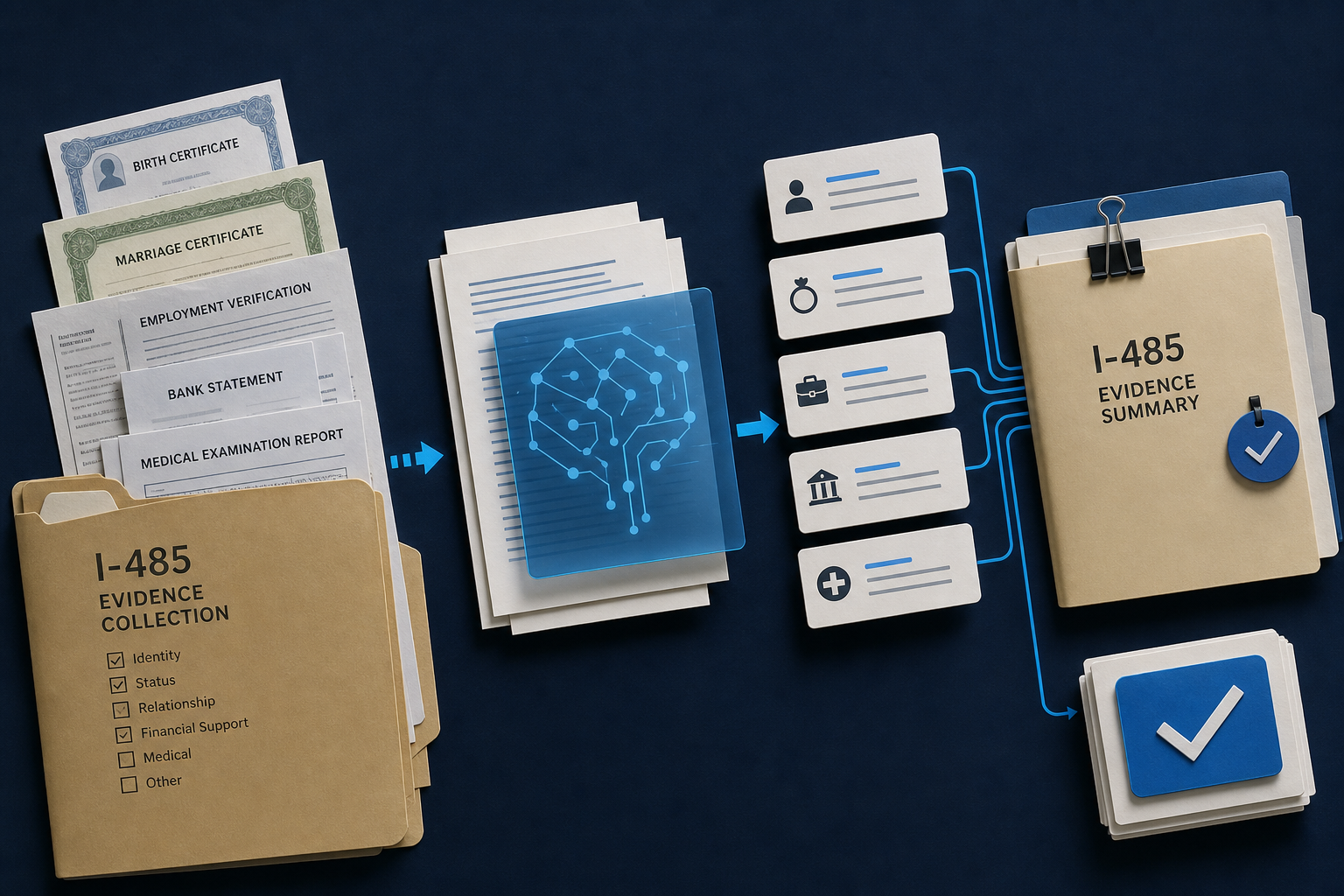
AI document extraction for I-485 evidence collection is transforming how immigration law teams assemble green card packages. This guide explains end-to-end processes that legal teams can implement to extract, classify, and validate evidence required for an I-485 adjustment of status filing. It walks through model selection, accuracy benchmarks, sample outputs, workflow integration with case management, and practical QA checks tailored to common I-485 evidence types.
Expect concrete, actionable steps, an implementation checklist, a comparison table of extraction approaches, and a JSON schema sample you can adapt. Table of contents: 1) Why use AI for I-485 evidence collection; 2) Choosing models and accuracy metrics; 3) Data extraction patterns for common I-485 documents and sample outputs; 4) Integration and workflow design with LegistAI; 5) QA, validation and audit controls; 6) Deployment, onboarding and ROI measurement; plus FAQs and next steps. This guide assumes your audience is legal decision-makers and practice managers evaluating software to increase throughput while maintaining compliance.
How LegistAI Helps Immigration Teams
LegistAI helps immigration law firms run faster, cleaner workflows across intake, document collection, and deadlines.
- Schedule a demo to map these steps to your exact case types.
- Explore features for case management, document automation, and AI research.
- Review pricing to estimate ROI for your team size.
- See side-by-side positioning on comparison.
- Browse more playbooks in insights.
More in Family-Based Immigration
Browse the Family-Based Immigration hub for all related guides and checklists.
Why AI Document Extraction Matters for I-485 Evidence Collection
Collecting evidence for an I-485 package is document‑intensive: birth certificates, marriage certificates, passports, employment letters, pay stubs, tax records, medical records, and prior immigration documents. Each document type has structured and unstructured elements that matter for eligibility, admissibility, and timeline verification. Manual triage creates bottlenecks and increases the chance of omissions. AI document extraction replaces manual data rekeying with automated extraction and classification to reduce time spent on routine data capture and to improve consistency across cases.
AI solutions like LegistAI are designed to integrate extraction into practice workflows, enabling immigration teams to route documents, populate case folders, and generate drafts for petitions and RFE responses. AI-assisted extraction is not a replacement for attorney review; it is a tool to reduce repetitive tasks, surface missing evidence, and standardize data used downstream in forms and filings. For managing partners and in-house counsel, the decision to adopt AI hinges on measurable outcomes: reduced case prep hours, fewer omissions, and a clear audit trail for compliance.
Key benefits specifically for I-485 evidence collection include: faster intake and classification of client-submitted documents; automated population of client folders in document management for immigration cases with client folders; support for multi-language intake (for example Spanish-language documents); and structured outputs that plug into document automation and draft generation. These benefits enable teams to scale caseloads without a proportional increase in staff, while preserving attorney oversight for legal analysis and final submissions.
Choosing Models and Defining Accuracy Benchmarks
Selecting the right AI model and setting realistic accuracy benchmarks are critical first steps for safe, compliant extraction of I-485 evidence. Model choices fall into three broad categories: OCR‑first with template matching, machine learning models trained on labeled examples, and hybrid systems that combine rules with ML extraction. For immigration documents, hybrid approaches often offer the best balance: OCR converts images to text, ML models classify documents and extract entities, and rules enforce field validation against form constraints and legal requirements.
Defining accuracy requires both quantitative and operational metrics. Quantitative metrics include precision and recall for entity extraction, field-level accuracy (the percentage of fields extracted correctly), and document classification accuracy (the percentage of documents assigned the correct type). Operational metrics include time-to-validate (how long it takes an attorney or paralegal to review extracted data), reduction in manual entry hours per case, and decrease in missing-evidence incidents during pre-filing checks.
Recommended benchmarks for pilot projects should be pragmatic. Begin with baseline measurements of manual processes (hours per case, common omission types). For entity extraction, aim to reach a field-level accuracy target that meaningfully reduces reviewer workload—often in the 85–95% range depending on field complexity—while ensuring a robust human-in-loop review for critical legal fields. Use an iterative approach: measure, retrain, and validate. Track model drift by sampling extractions over time and re-labeling problem cases for continuous improvement.
Evaluation and testing plan
Set up a blind test dataset that mirrors real client submissions: scanned images, photos from mobile devices, and multi-page PDFs that include both English and Spanish documents where applicable. Measure the following for each document type:
- Document classification accuracy — Does the model correctly label a birth certificate versus a passport?
- Field extraction precision — Are date fields, names, and document numbers captured precisely?
- Normalized output quality — Are normalized fields (e.g., standardized date formats, name parsing) accurate and ready for downstream automation?
Document the threshold for acceptable performance and map out remediation steps when the model fails to meet thresholds—these can include increasing training data, adjusting preprocessing (image enhancement, deskewing), or applying targeted rules for specific document types frequently misclassified.
Extraction Patterns and Sample Outputs for Common I-485 Evidence Types
Understanding common extraction patterns for I-485 evidence helps teams design templates, validation rules, and reviewer workflows. Below are common I-485 evidence categories with actionable guidance on which entities to extract, normalization rules, and sample output structures you can adopt in LegistAI. Sample outputs are presented as readable field groups; a JSON schema is also included later to illustrate structured output.
1. Passports and Travel Documents
Extraction focus: name (as appears on passport), passport number, country of issuance, date of birth, sex, nationality, issuance and expiration dates. Normalization: standardize dates to YYYY-MM-DD, parse name into given/family fields, and normalize country codes using ISO standards. For passports, add a classification confidence score and image thumbnail reference so reviewers can quickly cross-check the extracted fields against the page image.
2. Birth and Marriage Certificates
Extraction focus: full names, dates, place of birth or marriage location, issuing authority, registration number. These documents often vary by jurisdiction and language; implement language detection and localized extraction rules for Spanish-language certificates. Where certificates are issued in countries with non-Latin scripts, ensure OCR preprocessing supports transliteration or attach a manual verification flag.
3. Employment Letters and Pay Stubs
Extraction focus: employer name, position title, employment start/end dates, salary or pay period, pay stub dates, and employer contact. For pay stubs, extract pay period gross/net amounts and year-to-date earnings where present. Apply numeric validation (e.g., pay amounts parse as currency) and flag unusual anomalies for human review.
4. Tax Returns and W-2s
Extraction focus: taxpayer name, tax year, filing status, employer EIN, wages, and refund/owed amounts. Maintain a link between extracted fields and their original document pages for audit purposes. For complex tables (Schedule entries), extraction should capture both line labels and numeric values in a structured table format.
5. Medical Exam Records (I-693)
Extraction focus: patient name, date of exam, vaccinate records, clinician signature, and clinic information. These documents are critical for admissibility; include a verification flag for clinician credentials and ensure the extracted date aligns with filing windows.
Sample readable output (concise):
{
  "document_type": "passport",
  "confidence": 0.92,
  "extracted_fields": {
    "surname": "Gonzalez",
    "given_names": "Maria Teresa",
    "passport_number": "X1234567",
    "country": "Mexico",
    "date_of_birth": "1988-07-12",
    "issue_date": "2018-05-01",
    "expiration_date": "2028-05-01"
  },
  "page_images": ["s3://legistai/documents/1234/page1.jpg"]
}
LegistAI supports multi-field outputs like the example above and stores both structured fields and the original document image link to preserve auditability. Extraction outputs should include metadata: confidence scores, extraction timestamp, and reference to who reviewed or corrected the data.
Workflow Integration: From Intake to Petition Drafts
AI extraction is most valuable when embedded into end-to-end workflows, not treated as a standalone tool. LegistAI's design centers on integrating extraction outputs into case and matter management, document automation templates, and client communication loops. Below is a recommended workflow and an implementation checklist you can use to pilot extraction for I-485 evidence collection.
Recommended workflow steps
- Client intake and upload — Clients upload documents through the secure client portal into predefined client folders within LegistAI. Multi-language prompts guide Spanish-speaking clients.
- Preprocessing and OCR — Uploaded files are automatically preprocessed (deskew, denoise) and run through OCR.
- Document classification and extraction — AI classifies document types and extracts entities, attaching confidence scores and page references.
- Automated checks — System runs rules-based validations (date ranges, required fields for I-485 categories) and flags missing or low-confidence items.
- Human-in-loop review — Paralegals or attorneys review flagged items via a QA dashboard, correct extraction errors, and confirm completeness.
- Populate case templates — Verified fields auto-populate document templates and forms, and the system generates drafts (e.g., cover letters, evidence indexes) for attorney approval.
- Filing readiness and tracking — Final evidence package is compiled into client folders, with checklist items marked complete and deadlines managed via USCIS tracking and reminders.
Implementation checklist (pilot to scale)
- Define target document set for pilot (e.g., passports, birth certificates, marriage certificates, pay stubs, tax forms).
- Assemble a representative dataset of anonymized documents for model validation and training.
- Set accuracy and operational targets (document classification and field-level accuracy, reviewer time reduction).
- Configure preprocessing steps and language detection for Spanish documents.
- Map extracted fields into document automation templates used in practice.
- Design human-in-loop review queues and role-based access controls for reviewers.
- Establish audit logging and retention policies for extracted data and corrections.
- Run a timed pilot on a set of live cases and measure baseline vs. post-implementation metrics.
- Iterate on model retraining and rule enhancements based on pilot results.
Operational notes: To preserve security and compliance, ensure role-based access control and audit logs are enabled for extraction outputs. LegistAI stores extraction metadata alongside the original images so reviewers can see the context of each extracted field during review and later during audit or litigation support.
Quality Assurance, Validation, and Compliance Controls
Quality assurance is critical when automating evidence collection for I-485 filings. Even high-performing models produce errors; integrating QA and compliance controls ensures legal teams retain oversight and meet professional responsibility standards. This section outlines practical QA processes, validation rules, and compliance controls you should implement with AI document extraction.
Human-in-loop review policies
Design review thresholds based on risk: for low-risk fields like city names, a lower confidence threshold may be acceptable before human review; for legally significant fields (dates of birth, document numbers, or clinician signatures on medical exams), require direct verification regardless of confidence. Use reviewer queues to prioritize documents with missing required fields or low-confidence extractions. Track time-to-review to measure efficiency gains and identify bottlenecks.
Validation rules and automated checks
Implement field validation rules to catch common errors: date ranges (e.g., birthdates cannot be future-dated), numeric parsing for currency and social security-like numbers, and cross-document consistency checks (e.g., name spelling consistency between passport and birth certificate). Add business rules specific to I-485 categories—like ensuring continuous employment periods or matching sponsorship details—so the system can surface conflicts before attorney review.
Auditability and security
Maintain comprehensive audit logs that record extraction events, corrections, and reviewer actions. Enable role-based access control to restrict who can view or modify extracted data. Ensure end-to-end encryption in transit and at rest for all sensitive documents and extracted fields. Store metadata including extraction timestamps, model version used, and reviewer identity to support internal compliance reviews and external audits.
Error handling and retraining
Log and categorize extraction errors so you can prioritize retraining data. Use corrected extractions as labeled training examples to improve model performance. Maintain a versioning system for models so you can trace changes in extraction behavior to model updates. For high-volume errors tied to specific document types, combine targeted rule-based fixes (for predictable formats) with retraining to capture variability.
Practical tip: Require final attorney sign-off on all evidence indexes and substantive legal narratives. AI can prepare drafts and populate fields, but attorneys should certify factual accuracy and completeness prior to filing. This division of labor balances efficiency with professional responsibility.
Deployment, Onboarding, and Measuring ROI
Successful deployment of AI document extraction requires more than technology—it requires change management, training, and measurable goals. This section explains a phased deployment approach, onboarding best practices for staff, and the metrics that matter to decision-makers evaluating ROI for LegistAI.
Phased deployment approach
Start small with a pilot focused on a narrow set of document types and a defined caseload. The pilot should validate extraction accuracy, review workflows, and time savings. After pilot success, expand document coverage and integrate extraction outputs into more document automation templates and case types. Use incremental rollouts to manage risk and refine reviewer training materials.
Onboarding and training
Create role-specific training: paralegals need workflows for correction and queue management; attorneys need guidance on reviewing evidence indexes and approving final drafts; operations leads need dashboards for productivity and compliance. Provide quick reference guides, sample corrected cases, and regular feedback sessions where reviewers can surface recurring extraction failures for rapid remediation.
Metrics for ROI and continuous improvement
Decision-makers care about measurable outcomes. Track these KPIs over time:
- Hours saved per case — Time reduction in document intake and data entry.
- Reduction in missing-evidence incidents — Fewer requests from USCIS or internal rework.
- Reviewer throughput — Number of files processed per reviewer per day.
- Time-to-draft — Speed from intake to attorney-ready draft.
- Model performance over time — Field-level accuracy and classification rates.
To estimate ROI, combine time saved with average hourly labor rates to calculate direct labor cost reductions, and incorporate qualitative benefits like improved client experience and reduced risk of omissions. Use pilot results to set realistic expectations for scale and to build a business case for wider adoption across the practice.
Technical deployment notes: Ensure LegistAI is configured with role-based access control, audit logs, and encryption in transit and at rest before going live. Maintain a documented rollback plan in case model updates cause unexpected behavior, and schedule periodic reviews of model performance and feedback loops from users to keep the system aligned with practice needs.
Implementation Artifacts: Schema, Comparison Table, and Best Practices
Below are concrete implementation artifacts you can adopt immediately: a JSON schema for extracted I-485 evidence fields, a comparison table that contrasts manual, template OCR, and AI extraction approaches, and a set of best-practice recommendations for immediate application.
JSON schema example for I-485 document extraction
{
  "type": "object",
  "properties": {
    "case_id": {"type": "string"},
    "document_id": {"type": "string"},
    "document_type": {"type": "string"},
    "language": {"type": "string"},
    "extracted_fields": {
      "type": "object",
      "properties": {
        "surname": {"type": "string"},
        "given_names": {"type": "string"},
        "date_of_birth": {"type": "string", "format": "date"},
        "document_number": {"type": "string"},
        "issue_date": {"type": "string", "format": "date"},
        "expiration_date": {"type": "string", "format": "date"},
        "employer_name": {"type": "string"},
        "salary_amount": {"type": "number"}
      }
    },
    "confidence_scores": {"type": "object"},
    "page_images": {"type": "array", "items": {"type": "string"}},
    "review_status": {"type": "string", "enum": ["auto-verified", "requires-review", "verified"]},
    "audit": {
      "type": "object",
      "properties": {
        "model_version": {"type": "string"},
        "extracted_at": {"type": "string", "format": "date-time"},
        "reviewed_by": {"type": "string"}
      }
    }
  }
}
Comparison table: Manual vs. Template OCR vs. AI Extraction
| Approach | Accuracy | Setup & Maintenance | Scalability | Best used for |
|---|---|---|---|---|
| Manual data entry | Variable; depends on staff training | Low tech setup; ongoing labor costs | Scales with headcount | Small practices or one-off complex documents |
| Template-based OCR | High for predictable templates; low for diverse formats | Template maintenance required for each document layout | Moderate; struggles with new formats | Standardized forms with consistent layouts |
| AI-powered document extraction | Strong across diverse formats when trained and tuned | Initial model training and periodic retraining; rule tuning | High; adapts to new formats with feedback | High-volume, varied client document sets like I-485 evidence |
Best-practice recommendations
- Start with a limited document scope and expand as confidence and accuracy improve.
- Prioritize attorney review for legally significant fields while automating lower-risk tasks.
- Retain original document images and link them to extracted data for auditability.
- Use confidence thresholds to route documents to human reviewers efficiently.
- Track KPIs and maintain a retraining pipeline fed by corrected examples.
These artifacts and the table above will help you present a clear technical and business case internally. They also provide a practical baseline you can modify to align with your firm's policies, compliance requirements, and risk tolerance.
Conclusion
AI document extraction for I-485 evidence collection is a practical, high-impact automation that can free attorneys and paralegals from repetitive data entry while improving consistency and auditability. When implemented with a clear human-in-loop process, role-based controls, and documented QA checkpoints, extraction workflows integrate directly with case and matter management, document automation, and client portals to accelerate petition preparation and reduce omissions.
LegistAI is designed to embed AI-native extraction into immigration practice workflows, enabling your team to route documents, run validations, and populate petition drafts while preserving attorney oversight. Ready to evaluate how extraction can reduce prep time and improve compliance in your I-485 practice? Contact LegistAI for a tailored demo and pilot plan that maps pilot metrics, security controls, and onboarding steps to your firm’s needs.
Frequently Asked Questions
How accurate is AI document extraction for I-485 evidence?
Accuracy varies by document type, image quality, and the model's training data. Field-level accuracy is typically measured with precision and recall metrics, and practical deployments aim for a level that reduces reviewer workload while retaining human oversight for critical fields. Pilot testing on representative documents is essential to set realistic performance expectations and to configure review thresholds.
Which I-485 documents are best suited to AI extraction?
Passports, birth and marriage certificates, pay stubs, tax forms, and many standard medical records are well suited for AI extraction, particularly when documents are scanned or photographed clearly. Documents with non-standard formats or poor image quality may require additional preprocessing or manual review. LegistAI supports multi-language extraction workflows to manage Spanish-language documents commonly encountered in immigration practices.
How does human review fit into an AI extraction workflow?
Human review is an essential component. Configure confidence thresholds and rules so that high-risk or low-confidence fields are routed to paralegals or attorneys for verification. This human-in-loop model preserves professional responsibility: AI accelerates routine capture and flags anomalies, while legal professionals make case-specific determinations and certify final filings.
What security and compliance controls should I require?
Require role-based access control to restrict document and data access, maintain audit logs that capture extraction and review events, and ensure encryption both in transit and at rest for sensitive client records. Also document retention policies and maintain model versioning records to support audits and internal reviews. These controls help demonstrate due diligence and chain-of-custody for evidence used in filings.
How should we measure ROI for implementing AI extraction?
Measure hours saved per case in intake and data entry, reductions in missing-evidence incidents, reviewer throughput, and time-to-draft. Multiply time savings by average hourly rates for a straightforward labor cost reduction estimate, and factor in qualitative improvements like faster client response times and reduced rework. Start with a pilot and baseline metrics to quantify gains before scaling.
Can AI extraction handle Spanish-language documents?
Yes. Systems that support multi-language extraction include language detection and localized models or rules for Spanish documents. Ensure your pilot includes representative Spanish-language samples so the model can be validated and tuned for jurisdictional and terminological differences common in immigration evidence.
Want help implementing this workflow?
We can walk through your current process, show a reference implementation, and help you launch a pilot.
Schedule a private demo or review pricing.
Related Insights
- AI document evidence extraction for I-485 supporting documents: practical tutorial
- Automated collection and validation of I-485 supporting documents for immigration firms
- AI Document Extraction for I‑130 Supporting Documents: Accuracy, Integration, and Workflow
- Automated Document Ingestion for Green Card Evidence: AI Extraction and Evidence Building
- How to automate H-1B document collection with AI: complete guide for immigration teams